


Wrong Is Wrong, Even if Everyone Is Doing It. Right Is Right, Even if No One Is Doing It.

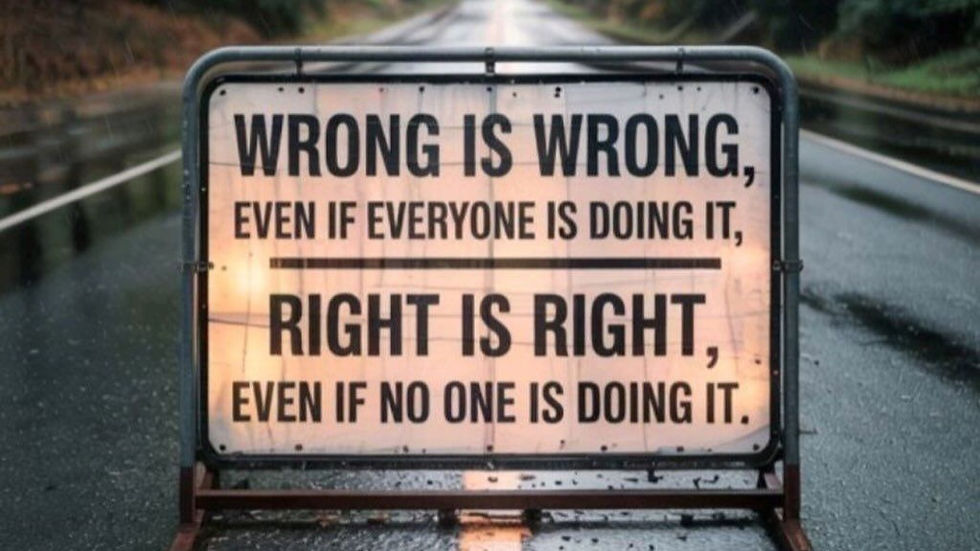
What is the ultimate test of a leader’s character when popularity, convenience, and corporate pressure demand compromise? It is the unshakeable courage to stand firm on moral integrity—knowing that wrong is wrong, even if everyone is doing it, and right is right, even if no one is doing it.
In a fast-paced world driven by quarterly metrics, short-term gains, and relentless competition, moral clarity is far too often treated as a luxury rather than a necessity. It is easy to do the right thing when the spotlight is bright, the audience is cheering, and the path is clear. But real integrity is forged in the shadows, when doing the right thing comes at a personal cost, and choosing the high road means standing entirely alone.
We live in a culture that frequently rationalizes ethical grey areas. Phrases like "that's just how business is done,""everyone else takes that shortcut," or "it's not technically against the rules" have become quiet justifications for compromising core values. Yet, true leaders understand that integrity is non-negotiable. Compromising your values to fit in, win approval, or secure a quick victory doesn't just erode your own character—it destroys the very foundation of trust within your organization.
The Slow Erosion of Organizational Integrity
Moral failure rarely happens in a single, catastrophic leap. It happens through small, seemingly insignificant compromises made over time. It starts when a leader ignores a minor breach of policy because a top performer was involved, turns a blind eye to unhealthy workplace behavior to "avoid conflict," or tweaks numbers slightly to meet a deadline.
When leaders normalize small ethical compromises, they give their teams permission to surrender their integrity entirely. Culture is defined by the lowest standard of behavior a leader is willing to tolerate.
When shortcuts and moral ambiguity become the standard operating procedure, the impact on an organization is devastating:
Psychological Safety Evaporates: Employees stop speaking up about flaws, risks, or unethical practices because they fear retaliation or isolation.
Trust Fractures: When team members realize that leadership values expediency over ethics, loyalty vanishes and cynicism takes over.
Top Talent Walks Away: High-integrity professionals will not stay in an environment where double standards thrive and principles are traded for profit.
When wrong becomes normalized, doing the right thing becomes an act of rebellion. But that rebellion is precisely what transforms ordinary workers into extraordinary leaders.
The Cost of Standing Alone: Why Moral Courage Is Rare
If doing the right thing is so critical, why do so many people choose the path of least resistance? Because standing up for what is right—especially when it goes against the grain—is lonely, intimidating, and inherently risky.
Human beings possess a deep, primal desire to belong. Group conformity exerts a powerful pull; when an entire room agrees on a questionable path, stepping forward to say "this isn't right" requires immense moral stamina. It means risking your popularity, your standing, and sometimes even your career trajectory.
Yet, history and corporate legacy teach us that every significant turn toward justice, truth, and excellence was started by someone who refused to go along with the crowd. True integrity doesn't ask, "Is this easy?" or "Is this popular?" It asks, "Is this right?"
When you choose to act with unwavering integrity, you send a clear message to everyone around you: values are not conditional. They are the anchor that keeps the organization steady when the storm hits.
The Power of Moral Clarity: The Tylenol Standard
To see what happens when leaders prioritize absolute integrity over financial convenience, look no further than Johnson & Johnson during the 1982 Tylenol crisis.
When tragedy struck, CEO James Burke didn't ask what was cheap, easy, or legally required. He looked at the company’s Credo—which placed human safety above profit—and immediately recalled 31 million bottles at a staggering financial cost. Burke proved that doing the right thing isn't conditional on profit margins. J&J's commitment to moral clarity didn't just save lives; it earned the company a legacy of trust that lasts to this day.
4 Principles for Leading with Uncompromising Integrity
Living and leading with integrity in a world of shortcuts requires deliberate effort. Here are four foundational principles to keep you grounded in doing what is right:
1. Establish Non-Negotiable Standards
Define your core values before you face a crisis. When you know what you stand for ahead of time, your response to ethical dilemmas becomes automatic rather than negotiable.
2. Protect the Whistleblowers and Truth-Tellers
Reward team members who have the courage to point out mistakes, raise concerns, or challenge unethical behavior. Create an atmosphere where speaking the truth is celebrated, not punished.
3. Choose Long-Term Legacy Over Short-Term Wins
Quick wins achieved through ethical compromises always come with hidden interest rates. Prioritize sustainable, honest success that allows you and your team to sleep well at night.
4. Be the Mirror for Your Team
Your team is watching every decision you make. When you choose integrity over convenience—even when it hurts—you set a powerful standard that elevates the entire organizational culture.
Integrity isn't about being perfect; it's about being undivided. It is ensuring that your actions match your values, regardless of who is watching or who agrees.
Protect Whistleblowers and Truth-Tellers: Championing Moral Courage
Let's expand on one of the principles mentioned above: protecting whistleblowers, because an ethical culture cannot survive if the people who expose wrongdoing face silence, retaliation, or career destruction for doing the right thing.
It takes immense bravery to stand up in a room full of peers or powerful superiors and say, "This is wrong." Yet, in far too many corporate environments, truth-tellers are viewed not as guardians of integrity, but as disruptors, disloyal employees, or troublemakers. When organizations punish or isolate individuals for raising ethical concerns, they send a chilling message across the entire workforce: keep quiet, turn a blind eye, and protect the status quo at all costs.
To build an organization where "right is right, even if no one is doing it," leaders must actively cultivate an environment of unshakeable psychological safety. Protecting whistleblowers goes beyond having a formal HR policy or an anonymous tip line—it requires a culture where moral courage is publicly honored and defended.
Look at the fall of Theranos. When researcher Tyler Shultz discovered that the company's blood-testing technology was failing, he took his concerns to executives. Instead of being protected, he faced intense legal intimidation and personal pressure to stay silent. Shultz refused to back down, eventually exposing a fraud that threatened real human lives.
When leaders suppress truth-tellers to protect short-term reputations, catastrophic failure is inevitable. True leaders don't surround themselves with silence—they protect and honor the people who have the courage to speak up.
How Leaders Can Safely Empower Truth-Tellers:
Eliminate Fear of Retaliation: Ensure that raising concerns never threatens an employee's job security, promotion trajectory, or daily working environment.
Respond with Gratitude, Not Defensiveness: When an employee brings a uncomfortable truth to light, thank them for protecting the organization's integrity instead of making them feel audited.
Take Action on Feedback: A reporting system is useless if bad behavior is swept under the rug. Leaders must demonstrate that reports lead to real, visible accountability regardless of the wrongdoer's title or revenue impact.
Normalize Healthy Dissent: Encourage teams to challenge decisions during meetings so that ethical considerations are vetted long before shortcuts are taken.
When truth-tellers are silenced, toxicity thrives. Championing those who speak up isn't just about risk management—it is how you safeguard your company's soul.
Leading with Courage: Building a Legacy That Lasts
At the end of your career, titles will fade, metrics will be archived, and past accomplishments will blend into history. What will remain is your character—the way you treated people, the standards you upheld, and whether you had the courage to do what was right when it mattered most.
When you refuse to follow the crowd into compromise, you become a lighthouse for others who are looking for direction. You give your team permission to act with honesty, stand up for justice, and build a culture where human dignity and moral courage prevail.
Be the leader who chooses principles over popularity. Stand firm in truth, uphold respect, and remember that doing the right thing is never the wrong decision.
Transform Your Leadership and Protect Your Workplace Culture
Building a culture of integrity, psychological safety, and human-centric excellence starts with courageous leadership. Ready to master the ultimate blueprint of human-centric leadership and cultivate a high-trust, ethical culture where your team thrives every single day? Order copies of my book The Blueprint of Leadership on Amazon for your entire team today. Let’s eliminate toxicity, uphold true values, and transform workplace cultures, together.
Invest in your team’s growth. Order on Amazon today: https://geni.us/s2nooOD


Comments