


The Shield vs. The Spectator: Why Defending Your Team is Non-Negotiable
- Gifford Thomas

- Apr 25
- 8 min read
Leadership is not a rank to be attained or a title to be flashed in a boardroom; it is a daily, conscious decision to place the needs, safety, and growth of others above your own comfort and career advancement. It is a sacred responsibility to the human beings in your care. In a corporate world often obsessed with quarterly metrics and personal branding, we are drowning in "bosses"—individuals who manage tasks, monitor clocks, and protect their own standing. What the world is starving for, however, are leaders who are willing to be the shield.
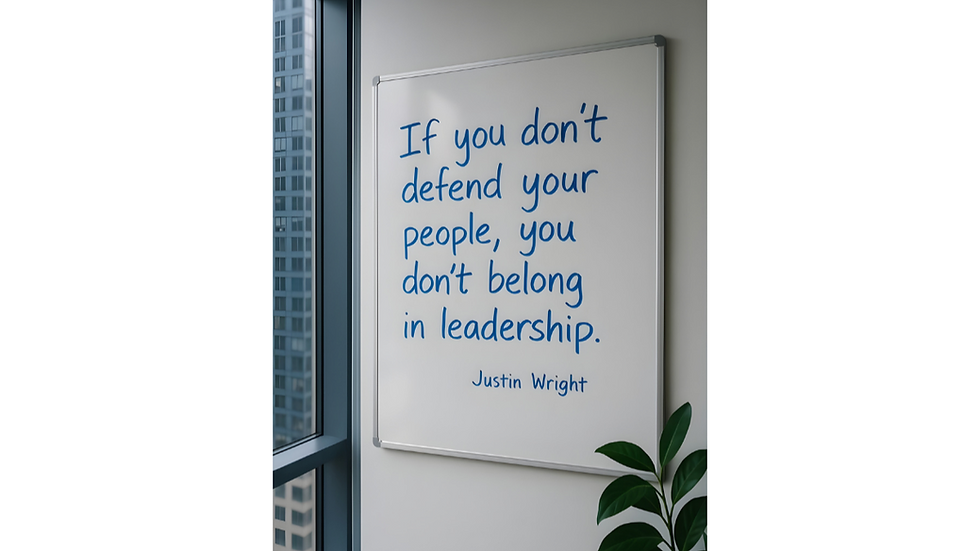
The fundamental truth of this calling is simple, yet most fail to grasp it: If you don’t defend your people, you don’t belong in leadership. Period.
The Silent Betrayal: When "Leaders" Fold
We have all seen it happen. A high-stakes project fails—perhaps due to shifting market conditions, a sudden pivot in executive strategy, or a chronic lack of resources that the team flagged months ago. In the boardroom, the air is thick with tension. An executive looks across the table, seeking a target for the disappointment.
This is the "Moment of Truth." This is where the mask falls.
A manager—someone who wears the title but lacks the soul of leadership—fears for their own reputation. They see the finger of blame circling and, instead of catching it, they point it downward.
"The team didn't execute," they say, their voice steady but their integrity crumbling. "They lacked the focus I expected."
In that single moment, leadership dies.
When you throw your people under the bus to save your own skin, you aren't just protecting your career; you are signaling to every remaining employee that they are disposable. You are committing a silent betrayal that dismantles the very foundation of greatness: Psychological Safety. Psychological safety is the single greatest predictor of high-performing teams. It is the belief that one will not be punished for making a mistake or speaking up. When a leader folds, that safety evaporates. People stop innovating because innovation requires risk, and risk-taking is impossible when you know your leader won't catch you if you fall.
The Leader Who Stood Firm: The Story of Melissa
Contrast that betrayal with a story of Melissa, a Director of Operations at a particular company. Her team had missed a critical shipping deadline for a major client—a mistake that cost the company a six-figure penalty. The CEO was livid, demanding a head on a platter.
Melissa knew exactly who made the error. It was a junior analyst named Marcus, a young father who had been working 14-hour days to keep up with an outdated manual entry system. Marcus made a clerical error at 10:00 PM on a Tuesday, when he was physically and mentally exhausted. Melissa didn’t offer up Marcus’s name. She didn’t mention the clerical error. She walked into the CEO’s office, sat down, and looked him in the eye.
"The responsibility is mine," Melissa said. "I am the one who signed off on the workflow. If there was a breakdown in communication, it’s because I didn't build a robust enough system to catch human error. My team worked 14-hour days to try and fix this. If you need someone to hold accountable for the operational design and the result, it’s me. Do not look at my team; look at me." Melissa didn't flinch. She knew that if she said Marcus made the error, Marcus would be fired. And she knew that firing Marcus wouldn't fix the problem—it would only create a culture of terror. She stood her ground for three specific reasons:
Systemic Ownership: She believed that a leader is responsible for the systems they oversee. If a clerical error could crash a project, the system was the failure, not the person.
Human Value: She knew the "hidden" work her team was doing. She had seen Marcus staying late, skipping lunches, and giving his absolute best. To punish that effort because of a single fatigue-driven mistake would be a moral failure.
Long-term Trust: She understood that you cannot buy loyalty; you earn it in the trenches. Melissa took the full force of that heat. She was passed over for her performance bonus that quarter—a significant financial hit. On paper, her record took a smudge. But do you know what happened to her team?
They became the most loyal, fierce, and productive unit in the company. Marcus found out what happened with Melissa and felt a deep sense of gratitude toward her because no one had ever stood up for him like that before. The atmosphere shifted from paralyzing fear to profound devotion. They didn't just work harder; they redesigned the entire data entry process on their own time to ensure Melissa never had to defend a mistake again.
They knew their leader was a shield, and they became an unbreakable fortress in return.
The Price of Admission: Taking the Dents
John Maxwell often says, "If you want the perks of leadership, you must pay the price of leadership." You simply cannot become a true leader without taking some dents. Leadership is an expensive calling. It costs you more than just your time; it costs your ego. If you aren't prepared to pay the following prices, you are simply a spectator in a suit:
The Price of Accountability: You must take 100% of the blame and give away 100% of the credit. When things go right, it was "the team’s brilliant execution." When things go wrong, it was "my failure in guidance."
The Price of Risk: Defending your people often means risking your own upward mobility. Standing up to a toxic superior to protect a junior employee requires "moral courage"—the willingness to put your promotion on the line to do what is right.
The Price of Integrity: Melissa’s story shows us that you might lose a bonus. You might be seen as "difficult" by those at the top who prefer compliance over character. But the "dents" on a leader's armor are not signs of failure; they are the badges of a protector.
When you defend your team against a powerful executive, you might risk your own promotion. You might be labeled "difficult" or "not a team player" by those who confuse "team player" with "yes-man or woman." You have to be willing to be the one who gets "the talk" from the board. You have to be willing to lose sleep so your team can sleep soundly.
But here is the truth: the price is worth it.
How to Defend Your Team: A Leader’s Playbook
If you want to be the leader your team deserves, you must move beyond the title and into action. Here is how you act as a shield:
1. Public Support, Private Coaching
Never, ever criticize a team member in front of others—especially not to your superiors. If a mistake was made, defend them publicly and take the hit. Then, behind closed doors, have the hard, honest, and empathetic conversation about how to improve.
2. Own the Environment
As a Founder or CEO, you are the filter between the organizational chaos and your team’s focus. If there is heat from the board or market pressure, absorb it. Don't let the "noise" reach the people doing the work. Create a sanctuary where they can excel.
3. Fight for Resources
Defending your team means ensuring they aren't set up for failure. If your team is burnt out, it is your job to say "No" to new projects until they have the headcount or tools they need. Learn to advocate for their time as fiercely as you advocate for the bottom line.
4. Stop the Gossip
Culture is defined by what a leader allows. If you allow people to speak ill of your team members in meetings—or if you participate in it—you have failed. Defending your team means shutting down back-channel politics and insisting on direct, healthy communication.
5. Fight for Their Growth
Sometimes defending your team means defending their future. When HR or upper management tries to cut training budgets or deny a well-deserved promotion, a leader fights. You must be the loudest advocate for your people’s careers, even if it means they eventually outgrow your department. Melissa’s story isn't just a "feel-good" anecdote; it is a masterclass in modern leadership. When you defend your people and truly care about every individual on your team, you aren't being "soft." You are becoming a true leader.
You are refusing to trade a temporary, superficial professional standing for the most powerful asset in business: unshakeable human commitment. By acting as a shield, you allow your team to stop spending energy on self-preservation. When they don't have to worry about the "bus" coming for them, they can spend 100% of their energy on achieving the organization’s vision and goals. You don't get world-class results from a team that is looking over its shoulder; you get them from a team that is looking forward.
The Final Charge: Are You a Boss or a Shield?
Leadership is a demanding path that tests the very core of your resolve, but the profound fulfillment found in transforming a life is the ultimate reward. While the weight of the role isn't for the faint of heart, there is nothing more uplifting than the realization that your guidance and protection cleared the way for others to thrive.
To every Founder, CEO, and Manager reading this: Take a moment today. Step out of your office, look past the spreadsheets, and truly look at your team. Observe the people who are pouring their talent, time, and energy into your vision. Now, ask yourself the only question that truly defines your right to lead:
"If the fire comes for them today, am I willing to stand in front of it?"
Leadership is a sacred responsibility to the human beings in your care. It is not a platform for self-promotion; it is a fortress for those you guide. If your honest answer to that question is "no"—if you find yourself calculating your own exit strategy or preparing to point a finger downward—then for goodness' sake, step aside. You are occupying space that belongs to a leader, and your presence is a bottleneck to their potential.
If, however, your answer is a resounding yes, then carry that responsibility with immense pride. Do not fear the conflict, the criticism, or the bonuses you may lose when protecting your people. Instead, carry those "dents" in your Armor with honor. Those marks are not signs of failure; they are proof of your character. They are the scars of a protector who understood that a leader’s primary job is to absorb the impact so the team can keep moving forward.
The price of leadership is undeniably high. It costs you your comfort, sometimes your reputation, and often your personal peace. But the reward is something money cannot buy and competitors cannot steal: a loyal, empowered, and high-performing team. When your team feels truly safe, their energy shifts from survival to innovation. They stop merely following instructions and start offering their full commitment. They transform into an unbreakable unit because they know their leader is a shield, not a spectator.
When your leadership is rooted in genuine care and your primary intention is to help people become the best versions of themselves, you unlock a profound law of reciprocity. Life has a way of returning that generosity to you, rewarding your investment in others with loyalty, success, and fulfillment in ways you could never have imagined. The world is already drowning in bosses. What it is starving for are leaders who have the courage to be the shield for their team.
P.S Our new Amazon Bestseller, The Blueprint of Leadership, Strategies For A New Era, is now available. Each page inspires you to embrace new perspectives, strengthen determination, and ignite action. Purchase your copy by clicking the link below.



Comments