


Integrity: Doing the Right Thing When No One Is Watching
- Gifford Thomas

- 10 hours ago
- 11 min read
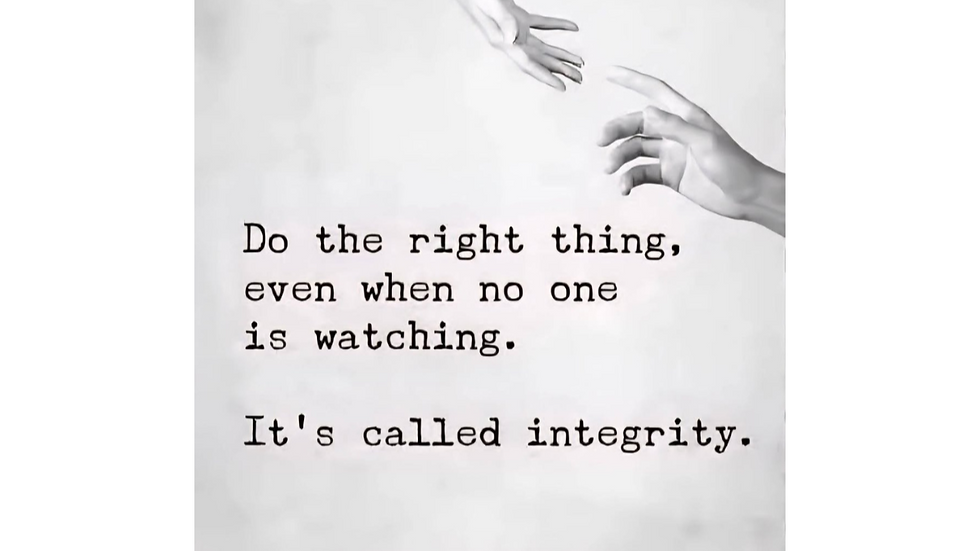
There is a distinct, quiet stillness to the moments when we are entirely alone.
Imagine it is 2:00 AM. You are sitting at your desk, the glow of your laptop screen illuminating an empty office. Everyone else has gone home. The cleaning crew has already emptied the bins. On your screen lies a financial report, a line of code, or a client contract. With a single backspace, you could cover up a minor mistake. No one would ever find out. It wouldn’t trigger an audit; it wouldn’t lower your bonus. In fact, fixing it the right way will cost you three more hours of sleep and a difficult conversation tomorrow morning.
What do you do?
The answer to that question doesn't just decide the fate of that report. It decides who you are.
We live in a world that is obsessed with the visible. We track likes, measure views, optimize algorithms, and curate flawless LinkedIn profiles. We are taught to broadcast our achievements and polish our public personas. But the true infrastructure of a human life—and the true bedrock of any great organization—is built on the things that never make it to a social media feed.
It is called integrity. And its simplest, most brutal definition is this: doing the right thing, even when absolutely no one is watching.
The Illusion of the Secret
We often trick ourselves into thinking that our private choices have no public consequences. We treat life like a series of isolated rooms. We think, "If I cut a corner here, it stays in this room."
But history, business, and human relationships tell a very different story. The universe has a strange, uncompromising way of bringing the things done in the dark into the blinding light of day.
Consider the collapse of corporate giants or the sudden downfall of revered leaders. Those catastrophes are rarely the result of a single, massive, spontaneous bad decision. Instead, they are the final, catastrophic landslide caused by years of tiny, invisible erosions.
It starts with a leader approving a slightly misleading metric because "it’s just for an internal presentation."
It continues when a manager looks the other way on a minor safety violation because they are behind schedule.
It solidifies when an employee takes credit for a colleague’s quiet contribution because they need to shine in a review.
Every time we compromise our values in secret, we aren't just breaking a rule; we are weakening our psychological foundation. We are telling ourselves that our character is up for sale, provided the price is low enough, and the audience is small enough.
Conversely, when you choose the hard right over the easy wrong in an empty room, something miraculous happens. You don't get a standing ovation. You don't get a trophy. But you walk out of that room with an unshakeable, quiet strength. You look in the mirror and respect the person looking back at you. That is a form of wealth that no economy can inflate, and no competitor can steal.
Real-World Integrity: The Power of the Unseen Choice
Integrity is not an abstract philosophical concept. It is a practical, daily practice that alters the course of lives and industries. Let’s look at two powerful examples of what happens when individuals and organizations choose the unseen right.
1. The Ultimate Standard: The Tylenol Crisis of 1982
In the fall of 1982, Johnson & Johnson faced a nightmare scenario. An unknown criminal had tampered with Tylenol capsules in the Chicago area, lacing them with cyanide. Seven people tragically died. The panic was nationwide.
The company’s CEO at the time, James Burke, faced a choice. Government officials advised him that a total recall wasn't necessary and could cause massive, unwarranted panic—not to mention the catastrophic financial ruin of their best-selling product. No one was watching Burke make his final decision in the boardroom except his inner circle. There was no public mandate to pull every bottle off the shelves.
Yet, Burke looked at the company’s "Credo"—a document written decades earlier stating that their first responsibility was to the doctors, nurses, and patients who used their products.
Burke chose integrity over profit. Johnson & Johnson immediately launched a nationwide recall of 31 million bottles of Tylenol, costing the company over $100 million at the time (worth hundreds of millions today). They didn't do it because they were forced to; they did it because it was the right thing to do to ensure human safety. They invented the tamper-evident packaging we use today. Because they acted with absolute honesty when the stakes were highest, they earned a level of public trust that allowed the brand to fully recover within a year.
2. The Quiet Heroism of Everyday Leadership
We don't just see integrity in multi-million-dollar crises. We see it in the trenches of everyday work.
Think of an engineering lead who discovers a bug in a software system just hours before a major product launch. The marketing team has spent six figures on the launch event. The executives are waiting. The bug is deep in the code—it might only affect 1% of users under rare conditions. The engineer could easily patch over it temporarily, launch on time, and fix it quietly later, blaming the issue on "user error."
But a leader of integrity stops the clock. They schedule the meeting, take the heat, face the frustrated stakeholders, and say, "We aren't ready. The product isn't safe for our users yet."
In that moment, that leader creates a cultural shift. The team members watching don't just learn how to fix code—they learn how to be human beings. They learn that their leader values truth over optics. And that creates a psychological safety net where excellence can actually thrive.
The Echo Effect: Why Teams Defect Without Integrity
If you are a leader, an entrepreneur, or a manager, you must understand one fundamental truth: Your team is always watching you, even when you think they aren't.
Culture is not what you write on the posters in the breakroom. Culture is the behavior you tolerate when you are stressed, and the choices you make when you think no one is keeping score.
"INTEGRITY IS THE MOST IMPORTANT CHARACTERISTIC OF A LEADER" - Warren G. Bennis, On Becoming a Leader
When a leader cuts corners, gossips about a colleague behind closed doors, or shades the truth to a client, an invisible poison spreads through the organization. The team picks up on the subtle cues. They realize that the stated values are just a performance. As a result, engagement plummets. Loyalty evaporates. Employees stop giving their best because they realize they are working in an environment built on sand.
But when a leader acts with integrity—admitting mistakes openly, giving credit where it is due, standing up for an employee even if it costs a client relationship—something extraordinary happens. A fierce, unbreakable loyalty is forged. People don't just work for a paycheck anymore; they work for a mission. They know their leader has their back, and they will run through brick walls to ensure the organization succeeds.
The Mirror Test: A Call to Absolute Self-Honesty
At the end of our careers, when the noise fades, the titles are stripped away, and the retirement parties are over, we are left with just one thing: our story.
We have to live with the knowledge of how we achieved what we achieved. Did we climb to the top by stepping on the fingers of those below us? Did we build our wealth on a foundation of half-truths and compromised ideals? Or did we build a legacy that can withstand the fiercest storms because it was anchored deep in the bedrock of integrity?
Integrity is a lonely path at times. It means saying "no" to easy money. It means accepting the blame when things go wrong and sharing the praise when things go right. It means having uncomfortable conversations instead of comfortable silences.
But it is the only path that leads to genuine, lasting fulfillment. It is the only way to build a brand, a career, and a life that genuinely matters.
Build a Culture That Does the Right Thing
The journey to building an unshakeable foundation of integrity doesn't happen by accident. It requires deliberate practice, constant alignment, and shared language across your entire organization. It requires equipping your people with the moral compass and the practical tools to navigate the complex gray areas of modern business.
If you are ready to transform your organization’s culture, inspire your people to reach their highest potential, and anchor your business in values that drive sustainable success, it’s time to take the next step.
Bring these vital principles into your next team meeting, leadership retreat, or training session. Equip your managers, inspire your executives, and empower your frontline employees to lead with honor when the lights are bright—and, more importantly, when the room is empty.
There is a distinct, quiet stillness to the moments when we are entirely alone.
Imagine it is 2:00 AM. You are sitting at your desk, the glow of your laptop screen illuminating an empty office. Everyone else has gone home. The cleaning crew has already emptied the bins. On your screen lies a financial report, a line of code, or a client contract. With a single backspace, you could cover up a minor mistake. No one would ever find out. It wouldn’t trigger an audit; it wouldn’t lower your bonus. In fact, fixing it the right way will cost you three more hours of sleep and a difficult conversation tomorrow morning.
What do you do?
The answer to that question doesn't just decide the fate of that report. It decides who you are.
We live in a world that is obsessed with the visible. We track likes, measure views, optimize algorithms, and curate flawless LinkedIn profiles. We are taught to broadcast our achievements and polish our public personas. But the true infrastructure of a human life—and the true bedrock of any great organization—is built on the things that never make it to a social media feed.
It is called integrity. And its simplest, most brutal definition is this: doing the right thing, even when absolutely no one is watching.
The Illusion of the Secret
We often trick ourselves into thinking that our private choices have no public consequences. We treat life like a series of isolated rooms. We think, "If I cut a corner here, it stays in this room."
But history, business, and human relationships tell a very different story. The universe has a strange, uncompromising way of bringing the things done in the dark into the blinding light of day. Consider the collapse of corporate giants or the sudden downfall of revered leaders. Those catastrophes are rarely the result of a single, massive, spontaneous bad decision. Instead, they are the final, catastrophic landslide caused by years of tiny, invisible erosions.
It starts with a leader approving a slightly misleading metric because "it’s just for an internal presentation."
It continues when a manager looks the other way on a minor safety violation because they are behind schedule.
It solidifies when an employee takes credit for a colleague’s quiet contribution because they need to shine in a review.
Every time we compromise our values in secret, we aren't just breaking a rule; we are weakening our psychological foundation. We are telling ourselves that our character is up for sale, provided the price is low enough and the audience is small enough.
Conversely, when you choose the hard right over the easy wrong in an empty room, something miraculous happens. You don't get a standing ovation. You don't get a trophy. But you walk out of that room with an unshakeable, quiet strength. You look in the mirror and respect the person looking back at you. That is a form of wealth that no economy can inflate and no competitor can steal.
Real-World Integrity: The Power of the Unseen Choice
Integrity is not an abstract philosophical concept. It is a practical, daily practice that alters the course of lives and industries. Let’s look at two powerful examples of what happens when individuals and organizations choose the unseen right.
1. The Ultimate Standard: The Tylenol Crisis of 1982
In the fall of 1982, Johnson & Johnson faced a nightmare scenario. An unknown criminal had tampered with Tylenol capsules in the Chicago area, lacing them with cyanide. Seven people tragically died. The panic was nationwide.
The company’s CEO at the time, James Burke, faced a choice. Government officials advised him that a total recall wasn't necessary and could cause massive, unwarranted panic—not to mention the catastrophic financial ruin of their best-selling product. No one was watching Burke make his final decision in the boardroom except his inner circle. There was no public mandate to pull every bottle off the shelves.
Yet, Burke looked at the company’s "Credo"—a document written decades earlier stating that their first responsibility was to the doctors, nurses, and patients who used their products. Burke chose integrity over profit. Johnson & Johnson immediately launched a nationwide recall of 31 million bottles of Tylenol, costing the company over $100 million at the time (worth hundreds of millions today). They didn't do it because they were forced to; they did it because it was the right thing to do to ensure human safety. They invented the tamper-evident packaging we use today. Because they acted with absolute honesty when the stakes were highest, they earned a level of public trust that allowed the brand to fully recover within a year.
2. The Quiet Heroism of Everyday Leadership
We don't just see integrity in multi-million-dollar crises. We see it in the trenches of everyday work.
Think of an engineering lead who discovers a bug in a software system just hours before a major product launch. The marketing team has spent six figures on the launch event. The executives are waiting. The bug is deep in the code—it might only affect 1% of users under rare conditions. The engineer could easily patch over it temporarily, launch on time, and fix it quietly later, blaming the issue on "user error."
But a leader of integrity stops the clock. They schedule the meeting, take the heat, face the frustrated stakeholders, and say, "We aren't ready. The product isn't safe for our users yet."
In that moment, that leader creates a cultural shift. The team members watching don't just learn how to fix code—they learn how to be human beings. They learn that their leader values truth over optics. And that creates a psychological safety net where excellence can actually thrive.
The Echo Effect: Why Teams Defect Without Integrity
If you are a leader, an entrepreneur, or a manager, you must understand one fundamental truth: Your team is always watching you, even when you think they aren't.
Culture is not what you write on the posters in the breakroom. Culture is the behavior you tolerate when you are stressed, and the choices you make when you think no one is keeping score.
"A culture of integrity cannot be mandated by human resources. It is caught, not taught."
When a leader cuts corners, gossips about a colleague behind closed doors, or shades the truth to a client, an invisible poison spreads through the organization. The team picks up on the subtle cues. They realize that the stated values are just a performance. As a result, engagement plummets. Loyalty evaporates. Employees stop giving their best because they realize they are working in an environment built on sand.
But when a leader acts with integrity—admitting mistakes openly, giving credit where it is due, standing up for an employee even if it costs a client relationship—something extraordinary happens. A fierce, unbreakable loyalty is forged. People don't just work for a paycheck anymore; they work for a mission. They know their leader has their back, and they will run through brick walls to ensure the organization succeeds.
The Mirror Test: A Call to Absolute Self-Honesty
At the end of our careers, when the noise fades, the titles are stripped away, and the retirement parties are over, we are left with just one thing: our story.
We have to live with the knowledge of how we achieved what we achieved. Did we climb to the top by stepping on the fingers of those below us? Did we build our wealth on a foundation of half-truths and compromised ideals? Or did we build a legacy that can withstand the fiercest storms because it was anchored deep in the bedrock of integrity?
Integrity is a lonely path at times. It means saying "no" to easy money. It means accepting the blame when things go wrong and sharing the praise when things go right. It means having uncomfortable conversations instead of comfortable silences.
But it is the only path that leads to genuine, lasting fulfillment. It is the only way to build a brand, a career, and a life that genuinely matters.
Build a Culture That Does the Right Thing
The journey to building an unshakeable foundation of integrity doesn't happen by accident. It requires deliberate practice, constant alignment, and shared language across your entire organization. It requires equipping your people with the moral compass and the practical tools to navigate the complex gray areas of modern business.
If you are ready to transform your organization’s culture, inspire your people to reach their highest potential, and anchor your business in values that drive sustainable success, it’s time to take the next step.
Bring these vital principles into your next team meeting, leadership retreat, or training session. Equip your managers, inspire your executives, and empower your frontline employees to lead with honor when the lights are bright—and, more importantly, when the room is empty.
Order copies of my Amazon Bestseller, "The Blueprint of Leadership," for your entire team today and let’s build a future of leadership we can all be proud of.
Invest in your team’s growth. Order on Amazon today: https://geni.us/s2nooOD



Comments